These 5 Threats Internet Users Fear
According to a Bitkom study, the majority of internet users feel threatened by cybercrime. From malware, online banking fraud, and hate speech – there are ways to stay protected.
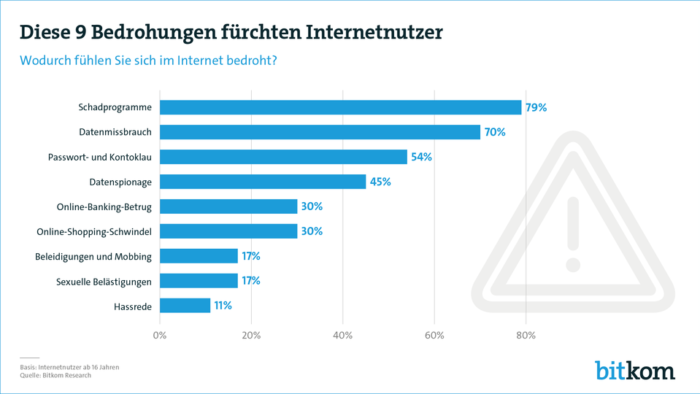
Source: Bitkom Research
1. Malware
The findings of the new Bitkom study show that eight in ten users (79 percent) feel threatened by malicious software such as viruses or Trojans on their smartphones or computers.
2. Data Misuse
The second biggest concern for Germans is the misuse of personal data. Seventy percent of online users feel threatened by violations of data protection rules, the unauthorized sharing of personal information, and its use – such as for targeted advertising.
3. Password and Account Theft
The idea that cybercriminals could exploit weak passwords to take over someone else’s online accounts makes more than half of all internet users (54 percent) fear for their security.
4. Data Surveillance
Is the state listening in? 45 percent of Germans are concerned that intelligence agencies are monitoring and storing their digital communications.
5. Online Banking Fraud
One in three users (30 percent) fears that strangers could access their finances or that they might fall victim to fraud while using online banking.
Other Concerns
Alongside online banking scams, just as many people fear fraud related to online shopping: placing an order, transferring payment, but never receiving the product.
One in six (17 percent) worry about cyberbullying and harassment on social networks and forums – a figure equal to those fearing sexual harassment online.
Hate messages and incitement to hatred are also spreading across the web. One in nine (11 percent) sees this as a personal threat.
Protection Against Cybercrime
To protect themselves from cybercriminals and these scenarios, users can rely on many proven measures. In addition to using complex passwords, password managers, and multi-factor authentication (MFA), simply staying alert makes a difference. Handle suspicious emails with caution and take security warnings seriously.
Regularly installing updates also helps close security gaps. For more information on internet security and how you or your business can stay protected online, visit Deutschland sicher im Netz and check updates regularly on securitytoday.de.
Fact: According to Munich Re, cyber insurance premiums rose by an average of 15 percent in 2024.
Fact: The Allianz Risk Barometer 2025 ranks cyberattacks as the top global business risk.
TL;DR
- Malware: The new Bitkom study shows that eight in ten users (79 percent) feel threatened by malicious programs like viruses or Trojans on their smartphones or computers.
- Data misuse: Seventy percent of internet users feel threatened by violations of data privacy policies, the sharing of personal data, and its use – for example, in advertising.
- Password and account theft: The idea that cybercriminals could exploit weak passwords to take over online accounts makes more than half of all internet users (54 percent) fear for their security.
- Online banking fraud: One in three users (30 percent) fears unauthorized access to their finances or being defrauded during online banking.
Key Facts
Cost per incident: A successful phishing attack costs companies an average of 4.76 million Euro.
Social Engineering: 98 percent of all cyberattacks involve at least one form of social engineering.
Frequently Asked Questions
Every question is locked. A tap unlocks the answer.
What are the most common cyber threats for businesses?
According to the BSI (Federal Office for Information Security) threat report, ransomware, phishing, DDoS attacks, and supply chain compromises are the most frequent threats. German companies also face regulatory risks (GDPR, NIS2 Directive).
How much should a company invest in cybersecurity?
Industry experts recommend allocating 10 to 15 percent of the IT budget to cybersecurity. According to Bitkom, German companies currently average 14 percent. What matters most isn’t just the amount spent, but the strategic distribution across prevention, detection, and response.
Does every company need a CISO?
Not every company needs a full-time Chief Information Security Officer (CISO), but every organization must have clear accountability for IT security at the executive level. SMEs can rely on an external CISO (Virtual CISO). Under the NIS2 Directive, management responsibility is now legally mandated.
Related Articles
- secIT by Heise 2026: The security roadshow for admins and IT managers
- DsiN Annual Conference 2026: Digital security in a connected society
- Cybersec Europe 2026: Brussels’ security conference at the heart of EU regulation
More from the MBF Media Network