Businesses Place Trust in Cloud-Based App Development
Which web applications are built in-house, and which are purchased as-as-a-service models? Here are the findings from Auth0’s U.S. survey “The State of Application Assembly Report
”.
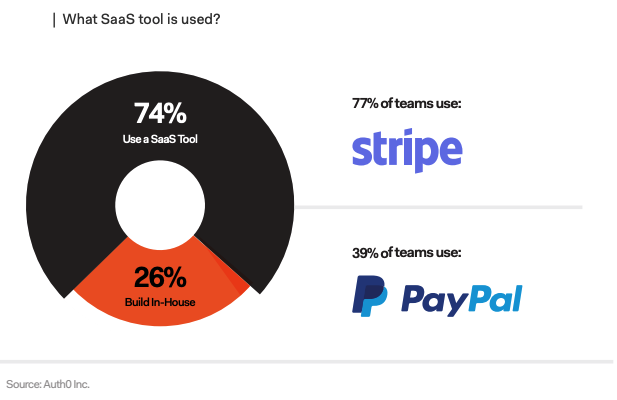
A key insight from the survey – conducted among 426 technical decision-makers (software architects, developers, and CTOs) – is that 74 percent rely on cloud-based services when deploying application-intensive solutions across their organizations.
Most Apps Are Built for External Users
Source: Auth0 / The 2020 State of Application Assembly
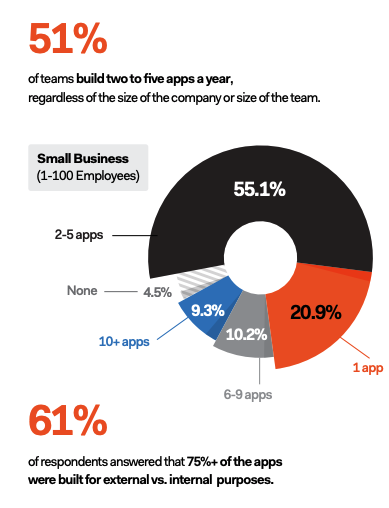
On average, 51 percent of respondents develop between two and five applications annually. Another 28 percent reported responsibility for developing six to ten applications per year. The study also found that three-quarters of all application demand targets external audiences – namely business customers or end consumers. According to current data from Statista, more than 4.1 million apps are currently available across global app stores – a strong indicator of massive development effort.
As-a-Service Dominance in Payments, Messaging, and Authentication
The researchers further correlated application procurement method with function. Their findings: For paid applications, 74 percent of respondents use an as-a-service model – with Stripe emerging as the preferred solution in the U.S. For messaging applications, 71 percent prefer Twilio’s cloud service. Authentication ranked third: 58 percent of respondents rely on external services for authentication. This suggests a significant portion of enterprises still build authentication solutions in-house – despite the high time investment involved.
According to the report, this area holds substantial optimization potential to improve efficiency and streamline processes. As new microservices accelerate time-to-market for internal development teams, homegrown solutions risk rapid technical and compliance obsolescence. Only gradually is the realization gaining traction that third-party vendors are better suited to procure and maintain applications – specializing in adapting their offerings to evolving market requirements, while freeing internal development teams to focus on other innovations.
Source: Auth0 / The 2020 State of Application Assembly
“These results confirm the growing trend toward relying on APIs and external SaaS services for application development – saving time, accelerating time-to-market, and ensuring access to the latest security standards,” says Martin Gontovnikas, Auth0’s Global Marketing Chief. “Whether for payments, messaging, or authentication, the survey shows teams are using more than just an ‘essential SaaS stack’ to speed up development.”
TL;DR
- A key insight from the survey – conducted among 426 technical decision-makers (software architects, developers, and CTOs) – is that 74 percent rely on cloud-based services when deploying application-intensive solutions across their organizations…
- Most apps are built for external users Source: Auth0 / The 2020 State of Application Assembly On average, 5…
- 28 percent reported responsibility for developing six to ten applications per year.
- According to current data from Statista, more than 4.1 million apps are currently available across global app stores.
“We’re seeing a similar trend in Germany: companies are increasingly losing confidence in in-house development. Constant adjustments and updates quickly make internal projects unwieldy. At that point, many switch to third-party services,” says Kevin Switala, Enterprise Sales Executive at Auth0 DACH.
According to U.S. analyst firm IDC, by 2022, 90 percent of all applications will incorporate microservices architectures capable of building, debugging, updating, and consuming third-party code. Combined with agile and DevOps approaches and methodologies, businesses can then dramatically accelerate digital innovation – up to 50-100 times faster than traditional methods.
For more information and full survey results, see “The State of Application Assembly”.
About Auth0
Auth0 is the leading identity platform for application developers building custom identity solutions. With the mission to secure digital identities worldwide – and thereby empower businesses to innovate – Auth0 delivers a simple, flexible, and scalable solution to comprehensively protect user-centric identities. Auth0 secures more than 100 million logins per day and enables enterprises such as Siemens, EnBW, and HolidayCheck to guarantee their customers secure, digital service access worldwide.
Learn more at https://auth0.com/de/ or follow @auth0 on Twitter.
Key Facts
Cloud security incidents: 45 percent of data breaches involve cloud environments.
Misconfigurations: 80 percent of cloud security incidents stem from misconfigurations.
Frequently Asked Questions
Is the cloud inherently safer than on-premises infrastructure?
Not automatically. While cloud providers typically offer superior physical security and patch management, responsibility for configuration, access management, and data protection rests with the customer (Shared Responsibility Model).
What is the Shared Responsibility Model?
Cloud providers secure the infrastructure (hardware, network, data centers); customers secure their data, access controls, and configurations. The precise division of responsibilities varies depending on the service model (IaaS, PaaS, SaaS).
Which cloud certifications should businesses prioritize?
ISO 27001, SOC 2 Type II, and C5 (BSI) are the most critical. For EU data protection compliance, it’s also essential to verify whether the provider processes data exclusively within the EU and adheres to the EU-U.S. Data Privacy Framework.
Related Articles
- Cybersecurity Trends 2026: The 7 Most Important Developments for Enterprises
- Cybersecurity 2025: A Year in Review – Incidents, Trends, Lessons Learned
- Post-Quantum Cryptography: Why Enterprises Must Act Now
More from the MBF Media Network
cloudmagazinSecuring Cloud MigrationHeader Image Source: iStock / gilaxia
Fact: According to AV-TEST, over 450,000 new malware variants are discovered daily.
Fact: Per the Allianz Risk Barometer 2025, cyberattacks are the top global business risk.


