AI Voice Clones: How DACH Companies Can Protect Themselves in 2026
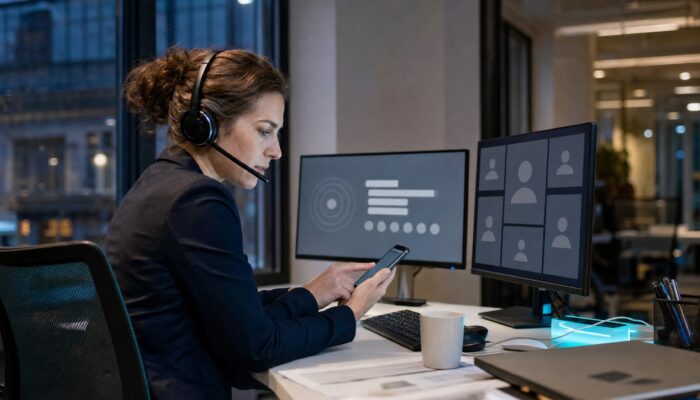
In February 2024, an employee at a Hong Kong corporation wired $25 million to fraudsters. He was in a video conference with the CFO and several colleagues-all familiar, all trusted. None were real. By 2026, a three-minute LinkedIn audio clip will suffice for a convincing voice-clone sample. What in 2023 required specialized tooling now runs in open-source pipelines that an eager intern can set up over a single weekend.
Key Takeaways
- Voice-cloning has become a commodity: By 2026, a three-minute audio sample will generate a voice model indistinguishable from the real person in a live call. The technical effort is minimal compared to classic spear-phishing.
- Attacks target processes, not SOCs: Traditional detection systems miss voice-clones. Effective defense requires procedural dual verification drilled into daily workflows.
- Awareness alone is insufficient: Employees in crisis scenarios trust a familiar voice. Relying solely on training means your risk assessment is incomplete.
Related:Adaptive MFA: default settings aren’t enough / AI-driven threat analysis for SOCs
Why 2026 marks a turning point
Voice-cloning isn’t new, but the barrier to entry has collapsed. Open-source models such as XTTS, Bark and numerous forks from Chinese and Eastern-European communities now run on an ordinary laptop. With three to ten seconds of sample audio, they produce a zero-shot voice that survives context stress in a phone call.
That shift has immediate operational consequences. In 2024, many assumed voice-cloning was a premium tool for elite crews; by 2026, every attack group will have it in its kit. Germany’s BKA Bundeslagebild on CEO fraud listed voice-cloning as a distinct modus operandi with measurable case volumes for the first time in 2025. Dutch police opened more than 200 voice-cloning-related cases in 2025, with similar figures reported in France.
In DACH mid-market firms, the topic rarely surfaces publicly because most incidents are quietly settled. Insurers report to the GDV quarterly increases in the low double-digit percent range, yet the numbers remain out of public view.
Three Attack Patterns That Pose Operational Risks
- CFO Instruction to the Finance Department. Classic CEO fraud, now with a synthetic voice. The call typically occurs outside business hours or on a Friday afternoon. The employee is pressured to approve an urgent transfer. The voice sounds stressed, amplifying the effect.
- IT Helpdesk Reset. A supposed employee contacts the internal or external IT helpdesk and requests a password reset or MFA reregistration. The voice matches a real person in the directory. Helpdesk staff are rarely trained to question a voice as a factor.
- Multi-party Conference with Synthetic Participants. The Hong Kong pattern. Instead of a single voice, a conference is staged where multiple known voices jointly authorize a transaction. Effect is significantly higher, while technical effort for attackers remains low.
In all three patterns, the risk does not lie in detection. It lies in the process gap beforehand.
What 2026 Reveals
- 3 to 10 seconds will be enough in 2026 to generate a sufficiently accurate voice-clone model using open-source pipelines, according to a comparative study by Fraunhofer AISEC in spring 2026.
- 43 percent of surveyed European mid-sized companies in the KPMG Cybersecurity Study 2026 lack a dedicated process for voice verification beyond basic awareness training.
- 25 million US dollars was the largest known single loss in 2024 from a multi-party voice deepfake. The dark figure in the DACH region is estimated as high by the Allianz Risk Barometer 2025.
What Actually Helps Operationally
There is no single technical lever that alone addresses the risk. What works is a combination of three building blocks that together close the attack window.
- Out-of-band verification as a mandatory step. Any instruction with financial impact or changes to IT privileges must be confirmed via a second, non-voice channel. Reply via Microsoft Teams chat, a signed email through a separate account, or a pre-agreed codeword.
- Helpdesk scripts with voice-suspicion pathways. Anyone calling the helpdesk to request a password reset or MFA reregistration must follow a standard verification that does not rely solely on voice. Ideally, verification via the identity provider system, not knowledge-based questions that can be harvested during social-engineering phases.
- Audit conference tooling. Conference bridges with liveness detection and speech-spectrum anomaly detection will be commercially available in 2026 for larger corporations. For SMEs, the out-of-band step is more relevant than this tooling.
Implementing all three components reduces risk-not to zero, but close. Implementing only one closes less than a third of the realistic attack window.
Why Classic Awareness Training Falls Short
Awareness training works for email phishing because there is time between receipt and action to question a message. With a voice call from the CFO in crisis mode, that time is absent. Studies from the UK’s NCSC and Germany’s DFKI show that even well-trained staff under time pressure tend to treat a familiar voice as validating.
This does not render training obsolete, but it relegates it to a supporting measure. Relying exclusively on training to counter voice deepfakes ignores research on human stress behavior. The real lever is the procedural obligation that kicks in even when an employee is convinced the caller is genuine.
Questions Supervisory Boards Should Ask in 2026
Three questions every German supervisory board should ask at least once in 2026. If the answers are vague, the risk position is vague.
- Which business processes can be authorized by a single voice in our company? The answer should be: none. Any other response signals an open window.
- How is our helpdesk trained against voice-based social engineering? What matters is not the date of the last training, but the script used during the call.
- What incidents have we experienced or nearly experienced in the last 24 months? The honest answer is rarely known by the executive board, but often by the CISO or compliance officer. If no near-misses are reported, there’s a reporting problem.
What Remains After the Hype Fades
In 2026, voice deepfakes will still be a crowd-pleasing slide in many presentations. What endures after the spectacle is a sober operational reality: processes that do not rely solely on acoustic identification are a prerequisite. They are not expensive to implement. They are tedious to roll out because they disrupt daily routines-precisely why they are often postponed.
If you don’t want to appear in a GDV statistic a year from now, don’t wait for the next incident. Attacks are not becoming less frequent.
Frequently Asked Questions
Every question is locked. A tap unlocks the answer.
Is a code word between the executive team and finance sufficient?
It’s a useful building block, but not a complete shield. Code words must rotate, must not appear in emails, and do not protect against helpdesk or conference-call attacks. Useful as an additional layer, not as primary defense.
Are technical voice-deepfake detectors reliable?
In 2026, the best commercial detectors achieve recognition rates between 70 and 85 percent on current open-source models. That’s helpful, but not enough on its own. Detectors serve as anomaly signals, not final verdicts.
How high is the actual risk for a mid-sized company?
Higher than many managing directors assume. Since 2024, mid-sized firms with three-digit order volumes have been targeted more often because verification processes are usually weaker than at large corporations. If you regularly process urgent wire transfers in five- or six-figure amounts, you’re a prime target.
Should we test voice-cloning tools ourselves to gauge our exposure?
A controlled, documented test led by the CISO and legal team is advisable to realistically calibrate your own susceptibility. Without such oversight, it’s a bad idea-employees will rightly sound alarms, and trust erodes.
What regulatory obligations already apply in the DACH region?
NIS2 requires critical infrastructure operators and important entities to implement risk management that implicitly covers voice deepfakes, even if not explicitly named. If you cannot detect or document a voice-fraud incident, you have a compliance gap. Concrete sanctions decisions in the DACH region remain rare in 2026, but are expected.
Editor’s Picks
Editor’s PickWhere the SME Sector Still Lags Technically on NISEditor’s PickNIS2 for Mid-Sized Firms: Achievable Steps, Avoidable MistakesEditor’s Pick72 percent of cyber defense comes from abroad



More from the MBF Media Network
cloudmagazinHow a Logistician Saved 31 Percent on Multi-Cloud CostsMyBusinessFutureCrisis Management Plan Over Crisis PR: Four Key Decisions for Small and Medium-Sized EnterprisesDigital ChiefsSenior Tech Talent 2026: The New Interface Profile