Protective DNS: the layer that many overlook
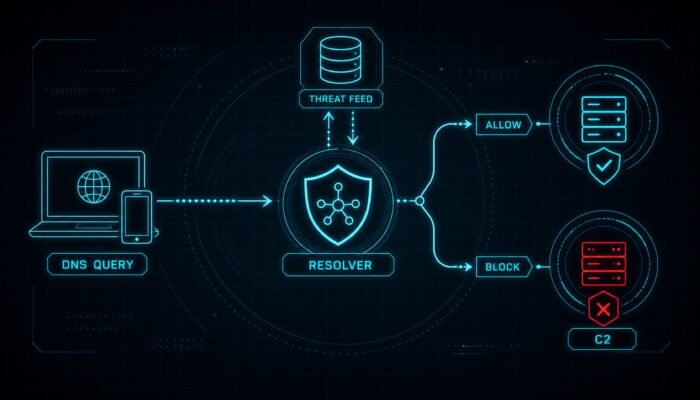
Before malware reaches its command-and-control server, it makes a DNS query. Before an employee lands on a fake login page, their device resolves its domain. Almost every attack stalls at a point most companies never inspect: at the DNS layer. Protective DNS plugs that gap-and it’s one of the cheapest security layers you can add.
Key Takeaways
- DNS is the common denominator: Malware control, phishing and data exfiltration nearly always start with a name lookup. If you don’t filter DNS, you’re ignoring the earliest detection stage.
- Protective DNS blocks at the root: A hardened resolver checks every request against threat intelligence and stops known C2 servers, newly registered domains and phishing pages before the connection is ever established.
- Encrypted DNS is the weak spot: DNS over HTTPS bypasses the corporate resolver-and the filter. If you don’t control this channel, you’re undermining your own protection.
Related:ITDR alongside SIEM and EDR: Detection architecture 2026 / Edge device as ransomware gateway: why MFA on VPN isn’t enough
Why attackers route through DNS
DNS is the internet’s address book. Every connection starts with a name being translated into an address-whether you’re visiting a website or malware reaching out to its command server. That’s why DNS is the one point almost every attack chain touches, whether it’s phishing, secondary payload delivery or covert data exfiltration.
Most defenses kick in later. Antivirus scans the file, the firewall inspects traffic, EDR watches endpoint behavior. The DNS request that came before often slips through unfiltered, often straight to a public resolver. That means missing the chance to stop an attack before it even establishes a connection.
This detection stage isn’t just early-it’s also inexpensive. If you already run DNS, which every business does, you can usually retrofit the protection with existing infrastructure. That makes Protective DNS one of the few security layers with an outstanding cost-to-benefit ratio.
What is Protective DNS? Protective DNS is a DNS resolver that checks every name lookup against threat intelligence and blocks or redirects requests to known malicious domains. Instead of returning a dangerous address, it serves a block page. Authorities like Germany’s BSI and security services in several countries explicitly recommend the approach.
What a hardened resolver blocks
A protective DNS service operates with blocklists fed by continuously updated threat data. Technically, it often implements this via Response Policy Zones-rules that refuse to resolve specific domains from the outset. The practical benefit lies in the categories it covers and the blind spots it deliberately leaves open.
What protective DNS delivers
- Blocks known command-and-control servers used by malware
- Stops phishing and typosquatting domains
- Acts early on freshly registered domains
- Provides valuable logs for detecting compromised hosts
Where the limits lie
- Unknown, brand-new domains slip through
- Direct IP-based connections bypass DNS entirely
- Encrypted DNS undermines the filter
- No substitute for EDR, patching, and segmentation
Protective DNS is therefore no silver bullet, but one layer in the stack. It removes a lot of early-stage load cheaply, yet it doesn’t replace later stages. Precisely this understanding determines whether its rollout ends as a genuine security gain or as a false sense of security.
The gap encrypted DNS opens up
The biggest practical stumbling block has an unassuming name: DNS over HTTPS. Modern browsers and many applications can send their DNS queries encrypted and straight to an external provider, bypassing the corporate resolver. From a privacy standpoint, this is intentional. From a defense standpoint, it’s a hole-because your own protective DNS filter never sees those requests.
Malware increasingly exploits this route, especially to evade filters. If you deploy protective DNS without controlling encrypted DNS, you lock the front door while leaving the window wide open. This is where I’ve seen setups that looked pristine on paper and failed completely in practice.
Countermeasures are known, but require discipline: enforce your resolver as the only permitted DNS path, block external encrypted DNS at the firewall, and grant exceptions deliberately and with documentation. Without this step, even the most polished filter remains powerless.
How to Implement Protective DNS
Implementation is straightforward if you follow the sequence. Starting to block domains before understanding what’s normal in your network mostly creates disruptions and erodes acceptance.
Frequently Asked Questions
Every question is locked. A tap unlocks the answer.
Does Protective DNS replace my firewall or EDR?
No. Protective DNS is an early, low-cost layer that stops many attacks before a connection is ever established. Firewalls, EDR, patching, and segmentation remain essential. Protective DNS simply lightens the load for those layers by intercepting threats before the handshake.
What’s the difference between Protective DNS and a normal DNS resolver?
A normal resolver resolves every request, even to malicious domains. A Protective DNS resolver checks each query against threat intelligence and refuses to resolve dangerous addresses-often via Response Policy Zones.
Why is encrypted DNS a problem?
DNS over HTTPS routes queries straight to external providers, bypassing your corporate resolver. Your filter can no longer see those requests. Without control over that channel, Protective DNS is easily circumvented-by users and malware alike.
Is Protective DNS suitable for smaller companies?
Especially for them. The effort is minimal; existing infrastructure or a hosted service usually suffices. For teams without a large SOC, it’s one of the few measures that delivers immediate, tangible impact with little ongoing maintenance.
How can I prevent legitimate services from being blocked?
Start in pure observation mode and roll out blocking gradually. Maintain a clean exception list and set up a clear process for reporting false positives to keep operational acceptance high.
Editor’s Picks
Editor’s PickPatch Prioritization: Why CVSS Alone Slows Down Your SOCEditor’s Pick14 Malicious npm Packages in Four Hours: Why Static Third-Party Checks Are No Longer EnoughEditor’s PickWhen HCI Turns Backup into an Attack Surface



More from the MBF Media Network
cloudmagazinIngress-NGINX is discontinued: The path to Gateway APIMyBusinessFuture13.3 million people retire: The baby boomer gap arrivesDigital ChiefsVMware under Broadcom: The Exit Plan as a Lever



Further reading

WithSecure: From Antivirus Pioneer to Cloud Security Specialist
WithSecure has been F-Secure’s B2B spin-off since 1 July 2022. Its Elements platform, co-security services and European data-protection focus aim to give security teams …


